Friday, July 9, 2010

Peace Corps sponsored seminar at the Library


On June 25th and 26th the Gasprinskiy Library hosted a gathering of librarians from across Crimea to discuss and learn about Crimean Tatar language and literature. Funded by a USAID grant I obtained through the Peace Corps (a grant program that is open to all Peace Corps Volunteers known as the Small Program Assistance ---SPA), the purpose of the seminar was to raise awareness of the state of Crimean Tatar language—it is now listed with UNESCO as one of the world’s disappearing languages—and to promote tolerance and understanding among the ethnic groups of Crimea. In the second phase of the project, we will help the participating librarians conduct similar seminars in their own regions.
The Simferopol training/seminar was a rousing success. Twenty-five librarians attended, representing all the regions of Crimea. Experts from the Crimean Engineering and Pedagogical University and the Ministry of Culture and Arts of Crimea provided training and lectures on Crimean Tatar language and literature. The Gasprinskiy staff provided the participants with a wealth of materials for their libraries, including biographies of famous Crimean Tatar writers and artists. We were also to provide each library with a copy of the new—and only—dictionary of Crimean Tatar/Ukrainian/Russian.
I presented a short presentation on my work at the library and talked about the role of the Peace Corps in community development. And, of course, I promoted the advantages of having a Peace Corps Volunteer assigned to one’s library. I know the community development program of Peace Corps Ukraine would like to partner with more libraries. It is a perfect fit for promoting the goals of the Peace Corps of providing technical assistance and mutual understanding and respect between the peoples of America and Ukraine.

Who is Ismail Gasprinskiy?


For the last 17 years, there has been an annual International Library Conference in the seaside town of Sudak in Crimea. Sponsored by the governments and libraries of Russia and Ukraine, the conference brings over 2000 participants from all over the world to discuss issues of contemporary libraries. At the conference, the Gasprinskiy Library traditionally has sponsored a roundtable for libraries from the Turkic speaking world. This year the theme of the roundtable was the writings and legacy of Ismail Gasprinskiy. The library asked me to do a short presentation on the works by and about Gasprinskiy available in English. I have been reading about Ismail Gasprinskiy since coming to the library including his one full length book translated into English, and was glad to have the opportunity to talk about this interesting and forward thinking individual.
Ismail Gasprinskiy (there are several different spellings of his last name—I chose to use the Crimean Tatar spelling for this blog) was a Crimean Tatar writer, educator, and activist who lived at the turn of the 20th century (1851-1914) and is generally considered to be the foremost modern thinker in the Muslim world of the Russian empire at that time.
Among his many accomplishments, Gasprinskiy was responsible for instituting a new system of Muslim education that revolutionized the traditional Islamic schools. By the time of his death, more than 5000 of these schools with a modern curriculum based on literacy and contemporary knowledge had been established across the Russian empire.
In addition to his work to modernize Muslim education, in 1883 Gasprinskiy started the first newspaper in Crimean Tatar history, called Tercuman (the Translator) which continued publication until four years after his death. In this paper, he espoused his modernist thinking, opening the minds of his Muslim readers to the broader world. He also used the paper as a vehicle to talk about women’s rights, an issue he believed fervently in. The only book length translation of his writings is the French and African Letters (annotated and translated by University of Southern California scholar Azade-Ayse Rorlich), a fictional travelogue that Gasprinskiy serialized in his newspaper.
In one of the episodes in the Letters, the protagonist and his traveling companions encounter a group of “Amazons” (the mythical women warriors) while traveling across the African desert. Gasprinskiy uses this episode to expound on his views of women:
“The life and courage of these amazons…clearly proved that education and world views could endow women with much courage, strength, and fortitude …It became clear that in other countries women were fearful, weak, had a delicate nature, frail nerves and no will of their own, not because this is how it should be, but because their education, world view, and those life conditions which had shaped them over time, had made them what they were.” Letter #20, French and African Letters.
Ismail Gasprinskiy was truly a remarkable individual, who was responsible for affecting the culture of his people in a way that opened their lives to the modern world. For this, he is considered the founding father of the modern Crimean Tatar nation.

Thursday, July 8, 2010

Photos of the Crimean Tatar Gasprinskiy Library

The library is used by teachers, students, researchers, and the general public looking for information on the Crimean Tatars. This is the reading room, where library users can spend time looking at the many documents on file at the library.


The reading room has a permanent display of traditional Crimean Tatar arts and crafts.


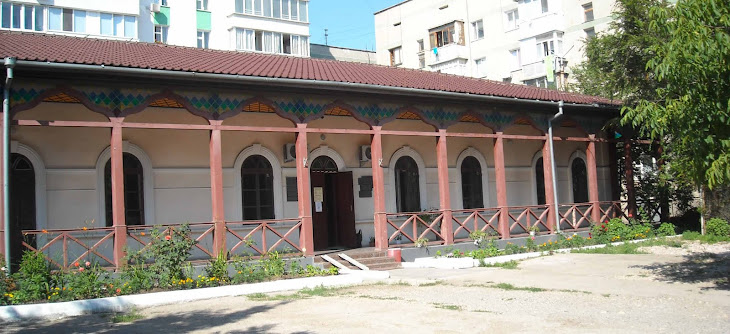
A plaque at the front door tells of the founding of the library and the date of its restoration with the help of the Netherlands government and the International Renaissance Foundation. Originally an Islamic school in the 1700 and 1800's, the building was restored in 1999.


The library hosts many events. On the wall of the reading room is a display about Cengiz Dagci, a Crimean Tatar writer who lives in London. The library held a celebration of his life and work on the occasion of his 90th birthday.

Tuesday, July 6, 2010

What is the Crimean Tatar Gasprinskiy Library?

As Crimean Tatars flooded back to their homeland in the late 1980’s and early 1990’s, they began to establish organizations to serve their returning people. In 1990, the Crimean Tatar Library in the name of I. Gasprinskiy (known as the Gasprinskiy Library) opened as a branch of the central library system in Simferopol, the capitol of the Autonomous Republic of Crimea in Ukraine. Five years later, it became an autonomous library under the Ministry of Culture in Crimea.
The mission of the library is to acquire, store, and make available to users of the library the world’s largest collection of documents in the Crimean Tatar language and about Crimean Tatars in other languages. Today, the library has a collection of more than 32,000 books plus 9000 complete sets of magazines and newspapers in the Crimean Tatar language; 4500 books in Turkish and other Turkic languages; and more than 2000 rare and valuable books.

Among the especially valuable collections in the library are:
• Photocopies of 61 volumes of the Kadyaskersky books which contain invaluable scholarly material on the stories, economy, laws, and social and demographic processes in the Crimean khanate from 1608 to1780;
• Microfilms of the newspaper Terdzhiman (Translator), published by Ismail Gasprinskiy from 1883-1918; a collection of the magazine Alemi нисван (The Female World); and the newspapers Millet (Nation) and Vetan Hadimi (Attendant of the Native land), 1905-1908;
• Complete editions of the works of Ismail Gasprinsky, Dzhafer Sejdamet, Bekira Choban-zade, Amet Ozenbashly, Asan Sabri Ajvazov, Osman Akchokrakly, Shevki Bektore, Arslan Krichinsky, Eshref Shemyi-zade and other outstanding figures of the Crimean Tatar culture;
• Crimean Tatar books published in Crimea before the Deportation of 1944;
• Complete set of the magazine Емеl (1930 to the present) and the magazine Kirim (1918);
• Complete set of the periodical Lenin Bayragi (Lenin Banner) which was published in the Crimean Tatar language by the Crimean Tatar diaspora in Uzbekistan from 1957 to 1990;
• Collection of the magazine Yildyz (Star), from 1976 to the present.

In 2000 the library opened a special section dealing with manuscripts and archival materials. The library staff research and acquire for preservation the personal archives of famous Crimean Tatar writers, scholars, and public figures, such as B. Garfarov, E. Semyi-zade, U. Kurkchi, and D. Ursu.

With the help of the International Renaissance Foundation in Ukraine, the library has produced a series of editions of Crimean Tatar writings and translations called Source of Knowledge. Sixteen books have been published through this program.

The Gasprinskiy Library also performs a number of services to benefit the Crimean Tatar community across Crimea. They hold frequent workshops and trainings, providing organizational and practical assistance to Crimean libraries serving the Crimean Tatar population. In addition, the library staff prepare Crimean Tatar language manuals and bibliographies to help disseminate information about Crimean Tatars and to serve their Crimean Tatar readers.

In its twenty years of existence, the Gasprinskiy Library has truly become the culture center of the Crimean Tatar people of Crimea. The library’s active assistance in the revival and development of Crimean Tatar language and culture has gone far in helping preserve and popularize the historical, spiritual, and moral heritage of the Crimean Tatar people.

Thursday, June 17, 2010

Who are the Crimean Tatars?

When I received my Peace Corps assignment to Ukraine, six months before I left the United States, I began to read about the country—its history, people, culture. A brief entry about the Crimean Tatar people, “a Muslim ethnic minority,” caught my interest. Who are these people that seem so different from what I think of as Ukrainians? I filed away the information I gleaned from books such as The Ukrainians: Unexpected Nation by Andrew Sullivan and began the process of packing up my life in America to go and live in another country thousand of miles away.
On April 1, 2009 I found myself with 35 other volunteers in the northern city of Chernigov to begin my 10-week training period in the Russian/Ukrainian language and the customs of Ukraine. As we struggled to learn the language and understand the peculiarities of life in another country, we continually speculated where we would end up in Ukraine, where we would be living and working for the next two years. Two days before we would be officially sworn into our service in the Peace Corps and depart for our site, it was finally revealed where each of us would be going. To my utter surprise and delight, when my name was called, I heard Simferopol, Crimea, and then to further intrigue me, I was told that I would be working at the Crimean Tatar Library in the name of I. Gasprinskiy. After a 15-hour train ride from Kiev to Simferopol with my new friend, my counterpart from the library Nadjie Yagya, I arrived in Simferopol and my new home, Ak Mechet, a Crimean Tatar settlement on the edge of Simferopol.
So here I am, one year later, living and working with Crimean Tatar people, a very different life than what I had imagined when I thought of myself as a “Peace Corps Volunteer in Ukraine.”
And exactly who are the Crimean Tatars? I have spent the last year trying to answer that question to myself, by reading what English language books and materials on Crimean Tatars that I could find, by talking in my very poor Russian with my neighbors and library staff, by observing and understanding as best I can, what goes on around me. Here is some of what I know:
The Crimean Tatars are a Turkic Muslim people who inhabited the Crimean Peninsula—the southern land mass of Ukraine surrounded by the Black Sea and Sea of Asov—for over seven centuries. For three hundred years, from 1441 to 1783 when Crimea was annexed by Russia, the Crimean Tatars ruled the peninsula through the Crimean Khanate. At the height of the Crimean Khanate, there were over six million Crimean Tatars inhabiting the peninsula, and at the time of annexation to Russia, they constituted 98% of the population. The intense Russification of the peninsula over the next century forced many Crimean Tatars to leave their homeland, and by the time of the Russian Revolution, there were only 300,000 Crimean Tatars left on the peninsula. Under the Bolsheviks a brief flowering of Crimean Tatar culture occurred between 1921 and 1927, and Crimean Tatar was made the official language of the peninsula along with Russian. However, Stalin’s repressive policies soon ended this “Golden Age” and resulted in further devastation of the Crimean Tatar people and culture, culminating in the mass overnight deportation on May 18, 1944 of all Crimean Tatars to Uzbekistan and other distant Soviet Republics. Over 46% of the Crimean Tatar population died during transport and in the subsequent camps, and almost all evidence of Crimean Tatar culture—mosques, place names, art and literature—were destroyed in Crimea, leading to the desired final solution of a “Crimea without Crimean Tatars.”
However, the Crimean Tatars--living in exile, not allowed to speak or teach their language, practice their religion, play their music, or write their stories--kept alive the dream of their homeland and formed a national movement which, after fifty years of nonviolent struggle, brought them back to their native land of Crimea. In 1985 the Crimean Tatars slowly began to return, a momentum that gathered strength as more and more restrictions were lifted, and in a 4-year period from 1989 to 1993, over 200,000 Crimean Tatars flooded back to Crimea. Today, an estimated 300,000 Crimean Tatars live in Crimea, constituting 13% of the population. They have an official governing body, representatives in the Crimea and Ukraine Rada (Congress), national schools that teach all subjects in Crimean Tatar, a university that educates Crimean Tatar language teachers, art and history museums, theater, radio and TV stations, and the Gasprinskiy Crimean Tatar Library where I so happily find myself working as a Peace Corps Volunteer.
This is just a very brief synopsis of who the Crimean Tatar people are, a culture that has a long history and is rich in many traditions. An excellent English language website to read more about the Crimean Tatars history, culture, and present activities is the website of the Diaspora group, the International Committee for Crimea, www.iccrimea.org.