Wednesday, July 13, 2011

The Multiethnic society of Crimea


The Gasprinskiy Library has always been interested in the diverse society of Crimea. Though Crimean Tatars consider themselves the indigenous people of Crimea, they also recognize that since ancient times, Crimea has been a multiethnic society. A notable phenomenon in recent years in the life of Crimea has been the study and revival of the traditions of peoples across national and cultural borders. For a number of years, the Gasprinskiy Library sponsored an international conference titled “The Library as a center of cross cultural dialogue in a multiethnic society.” They have also sponsored various workshops and trainings for the libraries across Crimea on working with the ethnic groups in their regions.
This month the Gasprinskiy Library has mounted an exhibition in the Reading Hall of the library called “Family Traditions of the Peoples of Crimea: Ethnicities and Cultures.” With books and photographs from the library’s collection and examples of handicrafts, the exhibition highlights the customs, traditions, festivals and rituals of the diverse people of Crimea: Ukrainians, Crimean Tatars, Armenians, Bulgarians, Hungarians, Greeks, Georgians, Jews, Azerbaijanis, and other peoples.
A note to the blog readers: This will be my last blog post for several weeks, as I will be traveling to America.

Thursday, June 30, 2011

Oral History Project at the Library


Brian Woods, a Master's candidate at Ohio University, began his
month-long internship at the library last week. His internship is
focused on building the library's capacity to record and archive
Crimean Tatar oral histories. Brian was a Peace Corps Volunteer for two years in Bakcheseray where he taught English.

As a student in International Affairs with a specialization in
Communication and Development Studies, Brian is excited about this
opportunity. "Helping empower under-represented minorities is at the
heart of CommDev as a discipline. Helping the library organize this
program...helping them take down people's stories about the
deportation, exile and return is so important, especially given the
implications in terms of displaced indigenous ethnicities in the
Middle East and Africa."

During his internship, he will teach simple best practices for oral
histories and help the library develop an archiving system.

Thursday, June 16, 2011

2011 International Library Conference in Sudak

Last week (June 6-10) was the annual International Library Conference in Sudak. Held for the last eighteen years in this beautiful town on the Black Sea coast, the International Library Conference is sponsored by the National Library of Russia and brings librarians from all over the world, including a few from the U.S. A special guest this year was the president of the International Federation of Library Associations, Ellen Tise, from the J.S. Gericke Library of the University of Stellenbosch in South Africa.

Official logo of the conference.

The Director (left) and Assistant Director (right) of the Gasprinskiy Library--Gulnara Yagyaeva and Leyla Kadyrova--are welcomed to Sudak.

The theme of this year’s conference was “Electronic Information, Libraries, and Society: What is to be Expected from the New Decade of the Information Century?” Despite a theme that focused on technology, there was a wide range of presentations and activities, including the Gasprinsky Library’s event. Every year at the conference the Gasprinsky Library hosts a roundtable for the librarians from the Turkic speaking countries focusing on a Crimean Tatar writer. This year the title of the roundtable was “Ashik Poetry of the Turkic World: Dedicated to the 390th anniversary of Ashik Omer, great poet of the Orient.” Ashik Omer was a Crimean Tatar poet, songwriter, and musician who lived in Evpatoria, Crimea, in the 17thcentury. He traveled worldwide and wrote over 2000 poems and songs. He is best known for his poems about love, but he also wrote about the social and philosophical issues of his day and about Sufi mysticism.

Statue of Ashik Omer in park in Evpatoria.

Elena Emirova from the Crimea Ministry of Culture and Gulnara Yagyaeva, Director of the Gasprinsky Library, opened the roundtable with a welcome to the participants and presenters.

Presentations were given by experts from the Crimean Engineering Pedagogical University in Simferopol and from several Turkic speaking countries.

Almakul Iskakova from the National Academic Library of the Republic of Kazakhstan, Astana, Kazakhstan

Zoya Mongush from the Tuvan Institute of Humanitarian Research in Kyzul, Republic of Tuva, Russia

The roundtable concluded with a performance of Ashik Omer's music and poetry by the Crimean Tatar folk ensemble Makyam.

Tuesday, June 7, 2011

Library Receives Cultural Heritage Grant

We received exciting news at the library—we were awarded a $15,000 grant to purchase equipment capable of scanning and digitizing the library’s collection of rare books, newspapers, journals, and other documents. Purchasing such equipment has long been one of the library’s goals as it is the first necessary step in the important work of preserving and digitizing the library’s rare collections. Here is the announcement of the award:

EMC AWARDS ‘INFORMATION HERITAGE’ GRANTS TO PRESERVE AND PROTECT THE WORLD’S CULTURAL INFORMATION
Eight Organizations From Around the World Honored as Information Heritage Stewards


HOPKINTON, Mass.—May, 23, 2011—EMC Corporation (NYSE: EMC) today announced that eight organizations will receive EMC Heritage Trust Project grants through the company’s Information Heritage Initiative program. The 2011 grants will support projects that digitize, protect and improve access to cultural information in communities around the world. Through the initiative, EMC has donated more than $20 million to date to help advance the preservation and accessibility of information heritage.
“Photographs, ancient writings, letters, film, music and visual art are all part of the world’s information heritage. Yet many of these historical treasures are at risk of disappearing,” said Bill Teuber, Vice Chairman, EMC Corporation. “Through the EMC Heritage Trust Project, we are dedicated to helping local community organizations worldwide preserve and protect these historic artifacts so that future generations can continue to enjoy and learn from them.”
The EMC Information Heritage Initiative program was formalized in 2007 to recognize organizations and individuals that protect and preserve invaluable cultural information from around the world through digitization, allowing readily accessible online research and education. Using the same criteria for excellence that guide this initiative and deployed in local communities, the EMC Heritage Trust Project was created to recognize and support people and projects that practice and inspire the digital stewardship of the world’s information heritage. For 2011, EMC received 95 applications from 19 countries for grant consideration.
The EMC Heritage Trust Project grant recipients were selected based on the following criteria: potential size of the audience that would benefit from access to this information; the at-risk status of the information and why it is urgent to digitize; and how significant the EMC grant would be to the overall success of the project.

The 2011 EMC Heritage Trust Project grantees are:

Canada: C.B. “Bud” Johnston Library, Western Libraries, University of Western Ontario -- The EMC grant will help digitize the entire Canadian Annual Reports Collection, the largest collection of corporate annual reports representing over 6,300 companies dating back as far as the 1920s.

Chile:
Organización Comunitaria Funcional (OCF) Londres 38, Memorial House -- The EMC grant will help expand the digital archive and update the online reference catalogue of Londres 38, a memorial space, to help protect records of the memories associated with the repression and violation of human rights that took place in Chile.

Chile: General Historic Archives of Ministry of Foreign Affairs of Chile -- The EMC grant will digitize 3,000 photographs from the General Historic Archive collection making them more readily accessible online. Most of these original photographs portray a wide range of Chilean and foreign social, political and diplomatic historical episodes from 1876 to 2006.

China: The Tongji University Library -- The EMC grant will digitize unique and valuable information from the Tongji University Library’s collection of books and antiquated texts published during the Republic of China. These resources are significant to the history of city planning and architectural development in the Yangtze River Delta.

Ireland: Boole Library, University College, Cork -- The EMC grant will support the creation of a publicly available digital archive of printed books and papers of mathematician George Boole. Boole laid the foundations in the latter half of the nineteenth century for a system of mathematical expression which formed the basis for all modern computer languages.

Kyrgyzstan: Public Association “Kyrgyz Kitep Borboru” -- The EMC grant will support the digitization of early Kyrgyz books in Arabic type, making selected resources available to the public. Resources include handwritten books and manuscripts which preserve and transmit the history, geography, and ethnography of their time.

Rwanda: Aegis Trust -- The EMC grant will support the creation of a unified digital repository of the Genocide Archive of Rwanda. Resources including audiovisual testimonies, historical photographs, documents, newspapers, and genocide victims’ information will be digitized and indexed to make the collection available to the public.

Ukraine: Crimean Tatar Library (in the name of I. Gasprinskiy) -- The EMC grant will digitize the Gasprinskiy Library’s collection of rare books and documents in order to preserve and publicize Crimean Tatar literature, language, culture, and history.

For more information on the EMC Heritage Trust Project, please visit: www.EMC.com/heritage_trust.

About EMC

EMC Corporation (NYSE: EMC) is the world’s leading developer and provider of information infrastructure technology and solutions that enable organizations of all sizes to transform the way they compete and create value from their information. Information about EMC’s products and services can be found at www.EMC.com.
Monday, May 30, 2011

Developing Volunteerism in Crimean Libraries: A two-day seminar sponsored by the Gasprinsky Library in partnership with the U.S. Peace Corps

On May 24th and 25th, we held a two-day seminar at the library on developing volunteerism in Crimean libraries. Soon after I came to work at the library in the summer of 2009, my partner at the library, Nadjie Yagya, and I attended a Peace Corps sponsored training in Kyiv on how to recruit, motivate, and manage volunteers in our organizations. The seminar was attended by Peace Corps Volunteers and their organizational partners from across Ukraine. The information we obtained at that training sparked the idea to organize a seminar at our library to promote volunteerism in Crimean libraries. We invited 35 librarians from all the regions of Crimea for a two-day seminar in Simferopol to learn from some of the experts that came to our training in Kyiv.

The seminar opened with a welcome from the new Minister of Culture in Crimea, Alena Plakida, who announced the appointment of Gulnara Yagyaeva as Director of the library. Gulnara Yagyaeva had been the acting director for a year, so we were all thrilled to have her appointment finally be permanent.

The participants were eager for a chance to learn about the possibilities for volunteerism in their libraries.

With the help of Elmas Emirova translating, I presented a slide show on volunteerism in American libraries. Practically every library in America has a volunteer group called Friends of the Library which helps the library with crucial tasks, particularly fundraising.

Constantine Yastrebova from Vinnitsa talked about the partnership of his organization with the city library to promote volunteerism.

Svetlana Cobova from the Youth Resource Center in the Cherkasy region talked about how to motivate volunteers to work in libraries and organizations.

Tatiana Orobchenko, Head of Youth and Family Services in the Poltava region, discussed the legal regulations concerning volunteers working in nonprofit organizations. She also showed many examples of some of the wonderful work of volunteers in the Poltava area.


Elena Ivanchenko and Peace Corps Volunteer Cheryl Pratt from the Sovetsky Central Rayon Library in eastern Crimea presented the Peace Corps sponsored project at their library. Called "Club Bluebird," it is a youth skills building club and has a multi media center to teach web design and other computer and internet skills.

Seminar participants worked in small groups to create innovative ideas for volunteer work at their libraries. Participants from one of the groups presents their ideas to the whole group.

Participants gather on the front steps of the library for a group photograph.

The two-day seminar will be followed by "Volunteer Days" in six regions across Crimea. These Volunteer Days will give local communities a chance to highlight the work of their libraries and nonprofit organizations and to recruit volunteers to their work.

Tuesday, May 17, 2011

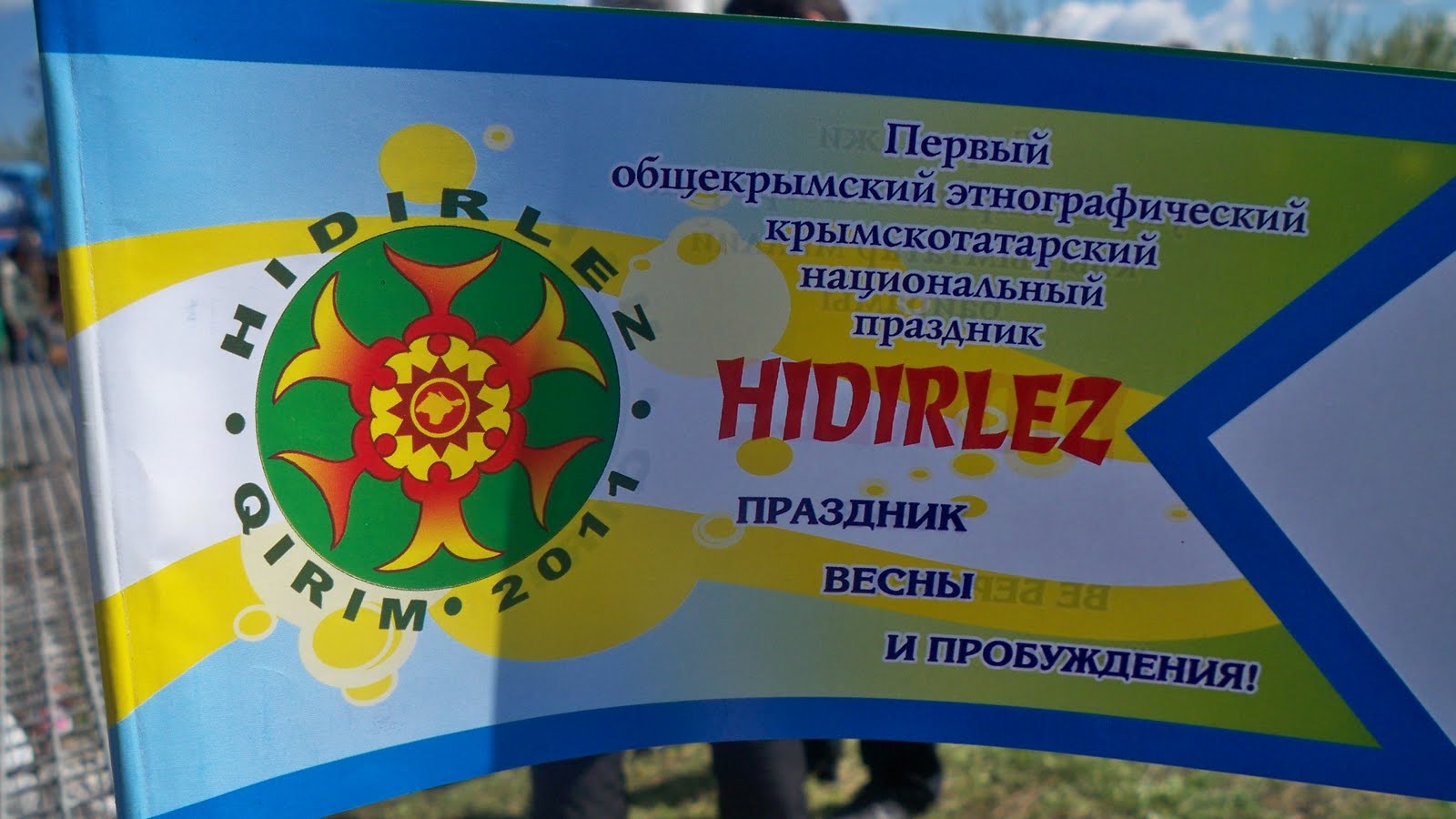
Hydyrlez--A Celebration of Spring


May 7, 2011 was the first large festival in the Simferopol region to celebrate the Crimean Tatar spring holiday called Hydyrlez. My partner at the library, Nadjie, had told me about it weeks ago, and we had made a plan to go together. However, she ended up not being able to go, so I went with another Peace Corps Volunteer, Cheryl Pratt, and my neighbor family. Staff at the Gasprinsky Library also went and set up a display of books about Hydyrlez in a booth they shared with the Crimean Tatar Art Museum.
Despite early morning chilly temperatures, the day turned into a beautiful sunny day with clouds floating across the distant green hills. Located about 20 kilometers from Simferopol, the festival was held on a large track of land with room for booths, performances, food, sports, and plenty of strolling around. The crowd was estimated at 7,000 to 10,000 people, and it was a great beginning for what will be an annual Crimean Tatar festival.

There were performances of traditional Crimean Tatar music and dance.

Beautiful crafts were for sale.

Many people enjoyed the performances on the large concert stage.

There was lots of wonderful Crimean Tatar food.

Thanks to Peace Corps Volunteer Cheryl Pratt for the photos.

Monday, April 18, 2011

The Peace Corps comes to the Library

Douglas Teschner, Director of the Peace Corps in Ukraine, meets with my counterpart, Nadjie Yagya, and head of the Bibliographic Department, Delyara Belyalova.

Doug found the Archive Department especially interesting because he used to work as an archivist. Here he is with Medine Alimova, head of the Archive Department, and Gulyara Abdurazakova.
The SNAC group--Peace Corps Volunteers over the ae of 50--gather in the Reading Hall of the Library.

Peace Corps Director Doug Teschner talks with the Volunteers while SNAC president, Jim Eleazer, looks on.
Last week there was a meeting of older (over the age of 50) Peace Corps Volunteers in Simferopol. The group, called SNAC (Social Networking Action Committee), meets three times a year in different regions of Ukraine in order to discuss business but also to tour the local area. I had offered to host the meeting in Simferopol with the idea of acquainting the Volunteers with Crimean Tatar history and culture.
Twenty-six Volunteers arrived on Friday, April 15th, along with the Director of the Peace Corps in Ukraine, Doug Teschner. I met Doug at the train station, took him to his hotel, and then brought him to the library. Unfortunately, the acting Director of the library, Gulnara Yagyaeva, was out of town and couldn’t meet with Doug, but the department heads all had tea with him and discussed the library activities. Afterwards, we took him on a tour of the building. He was very impressed by the library—its mission, staff, and resources—and by the work I and my counterpart do together.
Later in the afternoon, the entire group assembled in the Reading Hall of the library for a short meeting, plus I gave a presentation on the Crimean Tatar history and culture in preparation for our excursion the next day to the Khan’s Palace in Bakhchisaray and other Crimean Tatar historic sites. Being Americans, they were a somewhat noisy group, as there was animated discussion on many issues. But the Volunteers enjoyed seeing the library and some had also earlier in the day toured the Crimean Tatar Art Museum, who had a Peace Corps Volunteer a few years ago. We also went to another former Peace Corps Volunteer site, a Crimean Tatar crafts cooperative in Bakhchisaray (where I was happy to see people buying presents for themselves and family).
Though the weather didn’t exactly cooperate (we are having quite a cold and rainy spring here), it was a successful meeting, and I think fulfilled my goal of educating at least one group of Peace Corps Volunteers about the Crimean Tatar people.