Thursday, September 16, 2010

A new translation of the Koran

Lilia Kadirova introduces publisher Valery Basyrov.
The Koran in Ukrainian.
A well wisher greets Basyrov.
Basyrov is interviewed by the press outside the library.
A display of different editions of the Koran.
Yesterday (September 14, 2010), the Library hosted one of their frequent events in the Library’s Reading Room. The occasion for this event was a work-in-progress translation of the Koran into the Ukrainian language. Well-known Crimean writer and publisher, Valery Basyrov, presented the translation of the Koran he has been working on for a number of years. Though not yet finished, he has released ten advance copies and arranged this presentation in hopes of obtaining constructive feedback for the final translation.
Basyrov, whose mother is Polish and father Kazakhstan Tatar and whose grandfather was an imam, told about his impetus for the translation of the Koran into Ukrainian. Though not a speaker of Arabic which is the original language of the Koran, he has studied many translations of the Koran in Russian and Polish languages over the years and has attempted to create an accurate translation of the Koran into the Ukrainian language. At this event he gathered writers, representatives of the Mufti of Crimea, and scholars of the Koran to show them his efforts and to listen to their comments and suggestions.
Present at the event was the writer Risa Fazil who translated the Koran into Crimean Tatar, the Deputy Mufti of Crimea Eider Bey Ismailov, the chairman of the Ukrainian Information Center who expressed confidence that the translation will be welcomed by the Ukrainian community, a representative of the Crimean Tatar Educators’ Association, journalists, and others. All of them expressed their comments and good wishes for Basyrov.
Deputy Mufti of Crimea Eider said that the Ukrainian community is in need of a translation of the Koran into the Ukrainian language, that Islam is a religion for all people, regardless of nationality or language.
The Library prepared a display of different editions of the Koran in Crimean Tatar, Arabic, and Russian languages.
Though my very poor Russian and nonexistent Crimean Tatar and Ukrainian prevented me from understanding much of what was being said (this description is mostly taken from a Library press release), I nevertheless did grasp the essential reason for the event—the pending translation of the Koran into Ukrainian—and was grateful to be present at what I perceive to be a welcome expansion of an influential sacred text.

Saturday, September 11, 2010

The Lenin Banner

The first issue of The Lenin Banner, published in 1957 in Uzbekestan.

Alime Mennanova (left) and Nadjie Tairova on the front porch of the library, going through old issues of the paper and binding them into folders.
Nadjie Tairova
Alime Mennanova
One of the foremost missions of the Gasprinskiy Library is the collection and preservation of documents in the Crimean Tatar language and by and about Crimean Tatars in other languages. The Library has an impressive collection—over 40,000 documents including complete sets of magazines and newspapers published in the Crimean Tatar language.
When the Crimean Tatars were deported en masse by Stalin in 1944 to Uzbekistan and other distant Soviet republics, they were forbidden to use their native language. For thirteen years there were no written Crimean Tatar publications. When the ban was lifted, the first newspaper to be published in Crimean Tatar was the Lenin Bayragi, which means “Lenin Banner” in Crimean Tatar. Founded in 1957 in Tashkent, Uzbekistan, Lenin Bayragi was published three times a week and had an initial circulation of 23,000. It was published until 1990 when it ceased publishing for one year as Crimean Tatars flooded back to their homeland of Crimea. In 1991, the Committee to Assist the Deported Nationalities in Crimea revived the paper and began publishing it in Simferopol, Crimea. At that time, the newspaper changed names and became Yani Dunya, which means, appropriately enough, “New World” in Crimean Tatar. It continues today to be published on a weekly basis in Simferopol.
The Gasprinskiy Library collection of Crimean Tatar language documents contains a complete set of Lenin Bayragi. Full of information depicting the life of Crimean Tatars in exile in Uzbekistan, Lenin Bayragi is an important resource for the many researchers and students who use the library. Preservation of these newspapers and other vital documents is an ongoing task at the library, hindered by a lack of funding for the necessary equipment and materials. Ultimately, it is hoped that many of the library’s documents can be scanned and put into digital format for wider access for researchers and also to preserve the original documents. But for now, the newspapers are bound into folders and library patrons have access to them in the library reading room. Pictured are two of the librarians, Nadjie Tairova and Alime Mennanova, sitting out on the veranda of the Library on a hot summer day, sorting through the dusty old issues of Lenin Bayragi and binding them into the appropriate folders.

Thursday, August 19, 2010

A Crimean Tatar writer’s life is celebrated at the Library


Summer is a slow time here at the library. Many staff workers take their annual four-week vacation. Most stay at home and work on “home projects,’ much as we do in America. Others travel—my office mate Refika just returned from a trip to Uzbekistan with her daughter to visit her sister and other relatives there. Four-days, coming and going, on a hot, unairconditioned train. “Next time, I’m flying,” she said.
I spent a week in Belarus, accompanying a friend from America. Her parents were Holocaust survivors and were from Belarus (then Poland). She wanted to see the villages they lived in and talk to people who knew them, to find out what she could about the lives of her family before the Holocaust that killed almost all of them. It was an unforgettable experience, and I returned to Simferopol with a greater insight into some of the tortured history of this part of the world.
A Crimean Tatar writer’s life is celebrated at the Library
The Library holds many events throughout the year in its reading hall. Last spring there was a gathering to celebrate the life of Crimean Tatar novelist Cengiz Dagic on the occasion of his 90th birthday. Though Dagic was not in good enough health to attend (he lives in London), his sister was present, as were many scholars and friends. There were several speeches talking about his life and work, and performances of his poetry.
Cengiz Dagci is best known for the descriptions in his novels, poems, and writings about the Crimean Tartar life in Crimea from 1932 to 1945. Published in Turkey with some translation into Russian (unfortunately, I have not found any of his longer works translated into English), Dagci writes of the difficult life of the Crimean Tatar people during those years as they tried to find a way to survive the war between Nazi Germany and Russia, culminating in their eventual mass deportation in 1944. His work has been widely read in Turkey and is considered to be very important in keeping alive the plight of the Crimean Tatar people among Turkish people.
Cengiz Dagci was born in 1920 in Kiziltash, a village near Yalta. He attended school there and in Ak Mechet (then the name of Simferopol), and after finishing his secondary education in 1938, he went to the Crimean Pedagogy Institute where he studied for two years. In 1940 he was drafted into the military where he eventually served at the Ukrainian front and was captured by the Nazis. He escaped the prisoner camp and sought asylum in Great Britain. He settled in London in 1946 and has lived there ever since.
Here is a poem by Cengiz Dagci:
Aren't Crimean Tatars
a tree which is
supposed to die,
not to get greener
and not to give
new branches?
Since the day that they
lost their independence,
there wasn't any day
passed without
chopping the branches
of this tree, but
again new branches
came out of its body.
These branches were
not allowed to grow
and were chopped
again. But branches
came out again.
At the end,
this tree is chopped
at its root,
and thrown away
on a lonely, desert land.
But again new branches
come out of this body
and get longer and
longer, and they reach
to the land where
this tree was planted
one thousand years ago.

Tuesday, August 10, 2010

A Visit to the Krymchak Museum

A late 19th century Krymchak family.
This is a beautiful triptych painting that depicts in detail the history of the Krymchaks in Crimea.
Traditional Krymchak clothing
The entrance to the museum, located only a few blocks from the Gasprinskiy Library.
After the museum tour, we had tea with Qrimzalar Society members. The man in the middle with the white shirt is the artist of the triptych.
This week, Nadjie Yagya, my counterpart at the library, and I visited the Krymchak Museum in Simferopol and met members of the Qrimzahlar Crimean Republic Society for Culture and Enlightenment. A few weeks earlier I had met Rabbi Misha Kapustin, Rabbi of the Reformed Judaism synagogue here in Simferopol, and he had told me about the Krymchaks and offered to take me to the museum. I invited Nadjie to come along because although, of course, she knew about the Krymchaks, she was unaware of the museum.
The Krymchak Museum is a small but very well organized museum that gives the history of the Krymchak people in Crimea. The Krymchaks are a Jewish community that developed in Crimea in the medieval period of Crimean history. No one seems to know for sure what their origins are or how they adopted Judaism, but they were an established ethnic-religious group on the peninsula for many centuries, numbering approximate 7000 in 1913. Their dress, music, appearance, and customs were very closely tied to the Crimean Tatars, and they spoke a similar Turkic based language.
As professed Jews, approximately 80% of the Krymchak population was killed by the Nazis in the Second World War. Some Krymchaks were also deported along with the Crimean Tatars in 1944. Today, there are very few Krymchak people left, living mostly in Crimea and Israel, and according to the museum director, only one fully fluent native speaker. The Qrimzahlar Crimean Republic Society for Culture and Enlightenment was formed in 1989 to promote the preservation of the Krymchak cultural heritage.
One of the main goals of the Gasprinskiy Library is the preservation of the Crimean Tatar language, also an endangered language, with only 5% of Crimean Tatar children able to speak their native tongue. Nadjie and I have been discussing the possibility of a language training center devoted to the threatened Crimean languages of Crimean Tatar, Krymchak, and Karaite (another Jewish ethnic minority in Crimea), because they are all very similar Turkic based languages. Visiting the museum and meeting members of their preservation organization helped to give us the impetus we need to continue work on this important project. And I found out later that two of the museum staff want to come to my little English class at the library! So I look forward to future collaboration with the Krymchak people and learning more about their culture and how they coexisted side by side with the Crimean Tatars--Jews and Muslims together--for centuries.
For more information about the Krymchaks, see their website, www.crymchaks.org.

Friday, July 9, 2010

Peace Corps sponsored seminar at the Library


On June 25th and 26th the Gasprinskiy Library hosted a gathering of librarians from across Crimea to discuss and learn about Crimean Tatar language and literature. Funded by a USAID grant I obtained through the Peace Corps (a grant program that is open to all Peace Corps Volunteers known as the Small Program Assistance ---SPA), the purpose of the seminar was to raise awareness of the state of Crimean Tatar language—it is now listed with UNESCO as one of the world’s disappearing languages—and to promote tolerance and understanding among the ethnic groups of Crimea. In the second phase of the project, we will help the participating librarians conduct similar seminars in their own regions.
The Simferopol training/seminar was a rousing success. Twenty-five librarians attended, representing all the regions of Crimea. Experts from the Crimean Engineering and Pedagogical University and the Ministry of Culture and Arts of Crimea provided training and lectures on Crimean Tatar language and literature. The Gasprinskiy staff provided the participants with a wealth of materials for their libraries, including biographies of famous Crimean Tatar writers and artists. We were also to provide each library with a copy of the new—and only—dictionary of Crimean Tatar/Ukrainian/Russian.
I presented a short presentation on my work at the library and talked about the role of the Peace Corps in community development. And, of course, I promoted the advantages of having a Peace Corps Volunteer assigned to one’s library. I know the community development program of Peace Corps Ukraine would like to partner with more libraries. It is a perfect fit for promoting the goals of the Peace Corps of providing technical assistance and mutual understanding and respect between the peoples of America and Ukraine.

Who is Ismail Gasprinskiy?


For the last 17 years, there has been an annual International Library Conference in the seaside town of Sudak in Crimea. Sponsored by the governments and libraries of Russia and Ukraine, the conference brings over 2000 participants from all over the world to discuss issues of contemporary libraries. At the conference, the Gasprinskiy Library traditionally has sponsored a roundtable for libraries from the Turkic speaking world. This year the theme of the roundtable was the writings and legacy of Ismail Gasprinskiy. The library asked me to do a short presentation on the works by and about Gasprinskiy available in English. I have been reading about Ismail Gasprinskiy since coming to the library including his one full length book translated into English, and was glad to have the opportunity to talk about this interesting and forward thinking individual.
Ismail Gasprinskiy (there are several different spellings of his last name—I chose to use the Crimean Tatar spelling for this blog) was a Crimean Tatar writer, educator, and activist who lived at the turn of the 20th century (1851-1914) and is generally considered to be the foremost modern thinker in the Muslim world of the Russian empire at that time.
Among his many accomplishments, Gasprinskiy was responsible for instituting a new system of Muslim education that revolutionized the traditional Islamic schools. By the time of his death, more than 5000 of these schools with a modern curriculum based on literacy and contemporary knowledge had been established across the Russian empire.
In addition to his work to modernize Muslim education, in 1883 Gasprinskiy started the first newspaper in Crimean Tatar history, called Tercuman (the Translator) which continued publication until four years after his death. In this paper, he espoused his modernist thinking, opening the minds of his Muslim readers to the broader world. He also used the paper as a vehicle to talk about women’s rights, an issue he believed fervently in. The only book length translation of his writings is the French and African Letters (annotated and translated by University of Southern California scholar Azade-Ayse Rorlich), a fictional travelogue that Gasprinskiy serialized in his newspaper.
In one of the episodes in the Letters, the protagonist and his traveling companions encounter a group of “Amazons” (the mythical women warriors) while traveling across the African desert. Gasprinskiy uses this episode to expound on his views of women:
“The life and courage of these amazons…clearly proved that education and world views could endow women with much courage, strength, and fortitude …It became clear that in other countries women were fearful, weak, had a delicate nature, frail nerves and no will of their own, not because this is how it should be, but because their education, world view, and those life conditions which had shaped them over time, had made them what they were.” Letter #20, French and African Letters.
Ismail Gasprinskiy was truly a remarkable individual, who was responsible for affecting the culture of his people in a way that opened their lives to the modern world. For this, he is considered the founding father of the modern Crimean Tatar nation.

Thursday, July 8, 2010

Photos of the Crimean Tatar Gasprinskiy Library

The library is used by teachers, students, researchers, and the general public looking for information on the Crimean Tatars. This is the reading room, where library users can spend time looking at the many documents on file at the library.


The reading room has a permanent display of traditional Crimean Tatar arts and crafts.


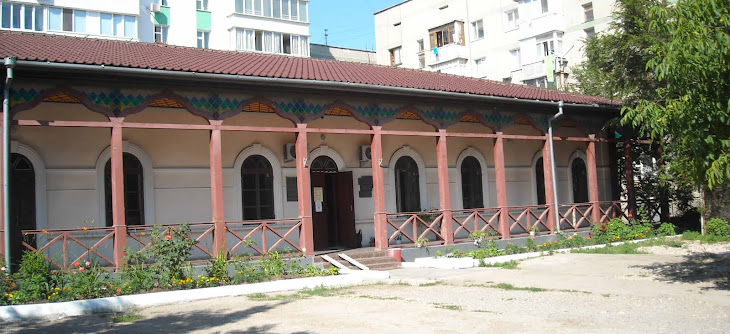
A plaque at the front door tells of the founding of the library and the date of its restoration with the help of the Netherlands government and the International Renaissance Foundation. Originally an Islamic school in the 1700 and 1800's, the building was restored in 1999.


The library hosts many events. On the wall of the reading room is a display about Cengiz Dagci, a Crimean Tatar writer who lives in London. The library held a celebration of his life and work on the occasion of his 90th birthday.